Penile Doppler Ultrasound on Long Island
Focused In-Office Blood-Flow Testing to Help Guide Your ED Treatment
What Is Penile Doppler Ultrasound?
A penile Doppler ultrasound — also called a penile duplex ultrasound — is a specialized in-office imaging test that measures blood flow inside the penis. It helps clarify whether arterial or venous blood-flow factors may be contributing to erectile dysfunction so treatment can be better tailored to you.
Erections depend on coordinated blood flow: arteries must deliver enough blood to fill the erectile chambers, and the veins must help keep that blood inside. A penile Doppler ultrasound provides useful measurements of both parts of that process and adds context to your symptoms, history, and treatment response.
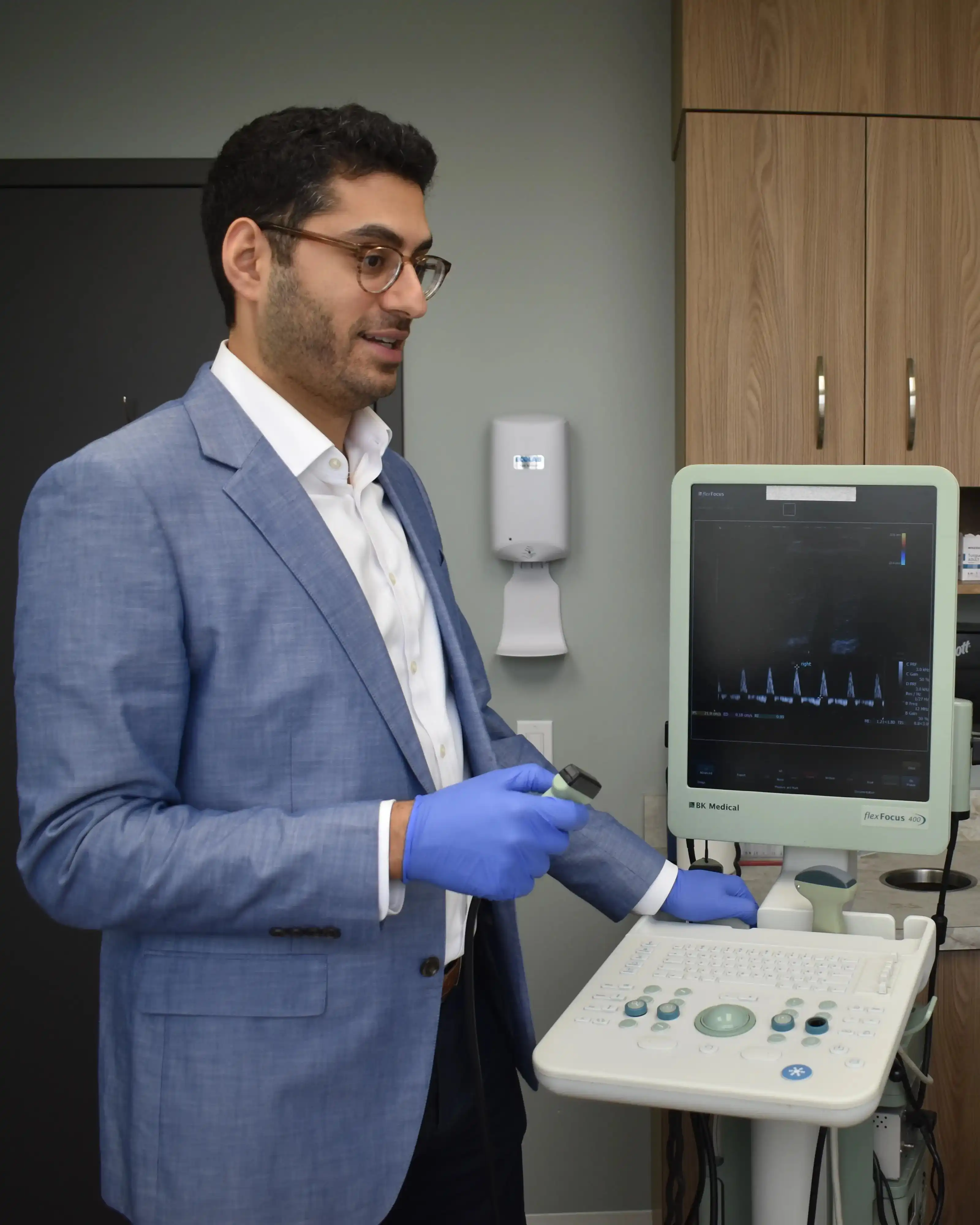
The test uses a standard ultrasound probe combined with Doppler technology to measure the speed and direction of blood flow in the penile arteries and veins. Because the penis must be erect for accurate measurements, a small injection of medication is given first to produce an erection. The ultrasound measurements are then taken while the erection develops.
Not available everywhere: Penile duplex ultrasound requires specialized training and equipment. Dr. Kashani performs this test routinely in-office at both of his Long Island locations — it is not a service offered at most general urology practices.
Who Benefits from Penile Doppler Ultrasound?
This test is most useful when the cause of erectile dysfunction is unclear or when you have not responded to pills and injections as expected. It is part of a thorough evaluation rather than a first-line test for every man with ED.
ED Not Responding to Pills
If Viagra, Cialis, or Levitra have not worked well for you, a penile Doppler can reveal why — and whether combination therapy, injections, lifestyle changes, or a penile implant are likely to do better.
Peyronie's Disease Evaluation
Ultrasound can locate scar tissue (plaques) and calcifications in the penis, measure the degree of curvature, and assess blood flow — all critical for deciding between Xiaflex, traction therapy, or surgery.
Post-Surgical or Post-Radiation ED
Men with ED following prostate cancer surgery, pelvic radiation, or other pelvic procedures often have vascular changes that the Doppler can quantify and guide treatment for.
Diabetes or Cardiovascular Disease
These conditions directly damage the blood vessels supplying the penis. A penile Doppler maps that damage precisely and helps select the treatment most likely to overcome it.
Younger Men with Unexplained ED
ED in young men is sometimes dismissed as psychological. A penile Doppler can confirm whether there is a real vascular issue — and in young men with arterial insufficiency, it may prompt evaluation for underlying cardiovascular risk.
Pre-Surgical Planning for Penile Implant
Before penile implant surgery, a duplex ultrasound provides a detailed picture of the vascular anatomy, detects any scar tissue or fibrosis, and confirms the implant is the right next step.
How the Test Works
The test is straightforward and performed entirely in the office. Most men find it much less daunting than they expected. Here is what happens, step by step.
Injection to Produce an Erection
A small amount of vasoactive medication (alprostadil or Trimix) is injected into the side of the penis using a very fine needle. This produces an erection within 5–10 minutes, independent of sexual arousal or nerve function — allowing objective measurement of the vascular system.
5–10 minutes to onsetUltrasound Measurement of Blood Flow
Once the erection develops, Dr. Kashani applies the Doppler probe to the base and along the shaft of the penis. He measures the arterial diameter, peak systolic velocity (PSV) — the speed of blood flowing into the penis during each heartbeat — and end-diastolic velocity (EDV) — the speed of blood flow at rest between beats. Multiple measurements are taken as the erection progresses.
15–25 minutesReview Findings and Next Steps
Dr. Kashani reviews the velocity measurements with you and explains what they mean. Results are discussed at the same visit. A formal follow-up is scheduled to present a complete treatment plan based on your results, history, and goals.
Same visit
About the injection: The medication used is the same as penile injection therapy for ED — a well-established treatment that is very safe. The erection typically resolves on its own within 30 to 60 minutes. Dr. Kashani has reversal medication available in the office if needed.
What Penile Doppler Results Can Tell Us
The blood flow measurements produce one of three main findings. Each one points toward a different treatment path and explains why certain treatments work for some men but not others.
Arterial Insufficiency
A low peak systolic velocity (PSV below 25 cm/s) means the arteries supplying the penis are not delivering enough blood. This is the most common vascular finding and is closely linked to cardiovascular disease, diabetes, smoking, and high blood pressure.
Treatment direction: Oral medications may help; penile injections are often more reliable; a penile implant is the most durable long-term option.
Corporal Veno-Occlusive Dysfunction
An elevated end-diastolic velocity (EDV above 5 cm/s) means blood is draining out of the penis too quickly for the chambers to stay filled. This is called venous leak and is one reason oral medications rarely provide satisfying results.
Treatment direction: Pills are typically ineffective; injections often work well; a penile implant provides the most reliable erections.
Neurogenic or Psychological ED
When both PSV and EDV are normal, the vascular system is working properly. The cause of ED is likely neurogenic (nerve-related) or psychological (anxiety, performance pressure, relationship factors). This is common in younger men.
Treatment direction: Oral medications usually work very well; behavioral approaches and counseling may also help.
Peyronie's disease findings: In men with Peyronie's disease, the ultrasound also identifies the location and density of scar tissue (plaques), detects calcifications, and assesses penile curvature. This information directly shapes the choice between Xiaflex injections, traction therapy, plication surgery, and penile implant with curvature correction.
Frequently Asked Questions About Penile Doppler Ultrasound
These are the questions men most commonly ask before and after the test.
Is penile Doppler ultrasound painful?
The test is well tolerated by most men. The injection uses a very fine needle and is similar to a standard penile injection — most men find it much less uncomfortable than they expected. The ultrasound itself involves gentle pressure with the probe but is not painful. Any discomfort during the erection phase is typically mild and brief.
What happens during the procedure?
Dr. Kashani injects a small amount of medication into the side of the penis to cause an erection. Once you have an erection, he applies the ultrasound probe to measure blood flow velocities in the penile arteries. The measurements are taken after the erection develops. Results are reviewed with you at the same visit.
What happens to the erection after the test?
The erection from the injection typically lasts 30 to 60 minutes and resolves on its own. Rarely, an erection can last longer — if yours persists beyond 4 hours, contact the office or go to an emergency room. Dr. Kashani provides clear instructions before and after the test, and reversal medication is available in the office if needed.
What do the results actually show?
The test measures the speed of blood flowing in and out of the penis. A low peak systolic velocity (PSV) indicates arterial insufficiency — the arteries are not delivering enough blood. An elevated end-diastolic velocity (EDV) indicates venous leak — blood is draining out too quickly. Normal readings in both suggest the cause of ED is neurogenic or psychological. For Peyronie's disease, the ultrasound also locates scar tissue and calcifications.
How does this test change my treatment plan?
Results help shape which treatment Dr. Kashani recommends. Men with arterial insufficiency may not respond well to pills alone and may benefit from combination therapy, injections, or a penile implant. Men with venous leak may see limited results from oral medications, while injections or an implant may be more effective. Men with normal vascular function may do well with pills or behavioral therapy. The study adds useful information to treatment selection.
Can the test also evaluate Peyronie's disease?
Yes — and it is routinely performed for this purpose. During the erect phase, the ultrasound can identify the location, size, and density of Peyronie's plaques, detect calcifications within the scar tissue, and assess the degree of curvature. This information is important for choosing between Xiaflex or Verapamil injections, traction therapy, plication surgery, or penile implant with curvature correction.
Is it covered by insurance?
In most cases, yes — when ordered for an appropriate medical indication such as erectile dysfunction evaluation, it is typically covered by insurance including Medicare. Dr. Kashani’s team will verify your specific coverage before scheduling and discuss any out-of-pocket costs in advance.
How long does the appointment take?
Plan for approximately 30 minutes total. This includes the injection, active imaging and time to discuss your results with Dr. Kashani before you leave.
Do I need to prepare for the test?
Preparation is minimal. You should avoid PDE5 inhibitors (Viagra, Cialis, Levitra, Stendra) for 24 to 48 hours before the test, as they can affect the results. Wear comfortable, loose-fitting clothing. You may eat and drink normally. Dr. Kashani’s team will provide a complete set of instructions when you schedule.
Should I have this test before considering a penile implant?
Dr. Kashani generally includes penile Doppler in the evaluation for men who are considering a penile implant. Understanding the vascular picture helps with surgical planning and confirms the implant is the right next step. It is also useful earlier in the process — for men who have not responded to pills, for younger men with unexplained ED, or whenever the underlying cause is unclear.
Why Choose Dr. Kashani for Penile Doppler Ultrasound?
Most urologists do not perform penile duplex ultrasound in their office — it requires specialized training, the right equipment, and enough experience to interpret results accurately. Dr. Kashani completed a dedicated fellowship in Male Sexual Health at Lenox Hill Hospital in New York City, where penile vascular assessment was a core component of training.
He performs this test regularly and uses the results to guide individualized treatment plans — not just to order a test, but to act on what it shows. If the Doppler reveals arterial disease, he has the full range of treatments available to address it. If it reveals venous leak, he can explain what that means and what options are realistic.
- Fellowship-trained in Male Sexual Health & Vascular ED
- In-office penile Doppler ultrasound at both Long Island locations
- Full spectrum of ED treatments: pills, injections, implants
- Peyronie’s disease evaluation in the same session
- Results discussed same day — no waiting for a separate report
- Private, discreet, judgment-free environment

Ready to Better Understand Your ED?
A penile Doppler ultrasound can provide useful information about blood flow and help guide your next step. Dr. Kashani performs this test in-office at both Long Island locations and reviews the results with you in plain language.